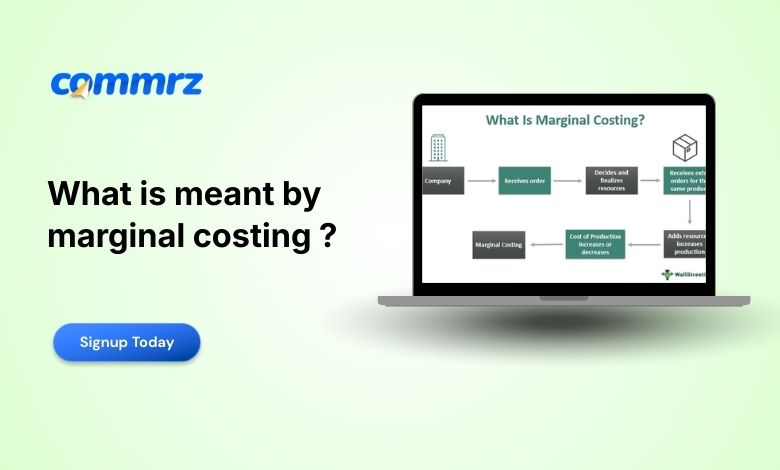
Marginal costing refers to a management accounting method that calculates the cost of producing one additional unit of a product. In simple terms, what is meant by marginal costing is that businesses include only variable costs—such as raw materials, labor, and direct expenses—while they treat fixed costs separately. Therefore, managers use marginal costing to make better decisions about pricing, production, and profitability.
Introduction
Every business must understand its costs in order to stay profitable. In fact, cost analysis plays a major role in pricing strategies, production planning, and financial decisions. One widely used accounting method for this purpose is marginal costing.
So, what is meant by marginal costing? Simply put, it focuses on variable costs that change with production levels. Fixed costs, however, remain constant and businesses treat them separately. As a result, companies can evaluate the financial impact of producing additional units.
Moreover, marginal costing helps managers identify profitable products and optimize production levels. Entrepreneurs running ecommerce stores especially benefit from cost insights like these. For instance, platforms such as Commrz help online sellers track pricing, manage margins, and make smarter business decisions.
Start Your Online Business with Commrz
Build, manage, and grow your ecommerce store with powerful tools designed for modern businesses.
Start Free with CommrzWhat Is Meant by Marginal Costing?
Marginal costing is an accounting technique where businesses include only variable costs in the cost of production. Meanwhile, they treat fixed costs as period expenses.
Because of this approach, managers can clearly see how production changes affect total costs. Consequently, companies can make better operational decisions.
- It focuses primarily on variable costs
- It separates fixed costs from product cost
- It helps managers evaluate profitability
- It improves pricing strategies

Marginal Costing in Management Accounting
Marginal costing in management accounting helps managers analyze how costs behave when production levels change. Therefore, companies use this method for planning and decision-making.
For example, businesses rely on marginal costing when they evaluate:
- Product pricing strategies
- Profit planning
- Break-even analysis
- Production optimization
Additionally, ecommerce entrepreneurs use similar cost insights when launching online stores. If you plan to start a fashion business, you may find this guide helpful:
How to Start a Luxury Clothing Brand
Marginal Costing Formula
The basic marginal costing formula calculates the cost of producing one additional unit.
Marginal Cost = Change in Total Cost ÷ Change in Quantity
Additionally, businesses often calculate contribution margin using the following formula:
Contribution = Sales − Variable Costs
Consequently, companies can determine how much profit remains after covering variable costs.

Marginal Cost Example
Let’s look at a simple marginal cost example.
A company produces 100 units of a product at a variable cost of ₹5,000. Now, suppose the company produces one additional unit and the total cost rises to ₹5,040.
- Change in cost = ₹40
- Change in quantity = 1 unit
Therefore:
Marginal Cost = ₹40
In other words, the company spends ₹40 to produce one more unit.
What Is Meant by Marginal Costing with Example
Consider a business that manufactures handbags.
| Cost Component | Amount |
|---|---|
| Raw Materials | ₹200 |
| Labor | ₹150 |
| Packaging | ₹50 |
| Total Variable Cost | ₹400 |
If the selling price is ₹700, then:
Contribution = ₹700 − ₹400 = ₹300
As a result, the ₹300 contribution helps cover fixed costs and generate profit.
Features of Marginal Costing
Marginal costing offers several key features that make it useful for financial decision-making.
- Businesses include only variable costs in product cost
- Managers treat fixed costs separately
- Companies calculate contribution margins
- It supports cost-volume-profit analysis
- Managers use it for short-term decisions
Advantages of Marginal Costing
Many organizations prefer marginal costing because it simplifies cost analysis.
- It simplifies financial calculations
- Managers make better pricing decisions
- Companies identify profitable products easily
- It improves production planning
- Businesses conduct break-even analysis more effectively
Furthermore, ecommerce entrepreneurs rely on cost insights when choosing online selling platforms. You can explore this comparison guide:
Best Platform for Building a Jewelry Ecommerce Store
Limitations of Marginal Costing
Despite its advantages, marginal costing also has certain limitations.
- It ignores fixed costs in product pricing
- It may underestimate total production cost
- Managers cannot rely on it for long-term decisions
- Incorrect use can lead to pricing errors

How Commrz Helps Businesses Manage Costs
Although marginal costing is an accounting concept, modern ecommerce platforms help businesses apply similar cost analysis in real life.
Commrz helps entrepreneurs:
- Track product pricing and profit margins
- Manage inventory costs
- Analyze product profitability
- Optimize ecommerce operations
Additionally, you can explore more business insights on the Commrz Blog. You can also learn from industry experts through the Commrz Author Page.
If you want to start selling jewelry online, read this guide:
Best Platform to Sell Jewelry Online in India
Furthermore, you can explore Commrz resources and community links here:
Watch: Marginal Costing Explained
Embed YouTube video using WordPress shortcode
Launch Your Ecommerce Store with Commrz
Create and grow your online store with powerful ecommerce tools.
Create Your Store